


Super Space By Paul Davies
Super space
by Paul Davies
In the domain of the quantum the apparently concrete world of experience dissolves away among the melee of subatomic transmutations. Chaos lies at the heart of matter; random changes, restrained only by probabilistic laws, endow the fabric of the universe with a roulette-like quality. But what of the arena in which this game of chance is being played - the spacetime background against which the insubstantial and undisciplined particles of matter perform their antics? In chapter 2 we saw how spacetime itself is not as absolute or unchanging as traditionally conceived. It too has dynamical qualities, causing it to curve and distort, to evolve and mutate. These changes in space and time occur both locally, in the vicinity of the Earth, and globally as the universe stretches with its expansion. Scientists have long recognized that the ideas of quantum theory should apply to the dynamics of spacetime as well as to matter, a concession which has the most extraordinary consequences.
One of the more exciting results
of Einstein's theory of gravity - the so-called general theory of
relativity - is the possibility of gravity waves. The force of gravity
is in some respects like the force of electricity between charged
particles, or the attraction between magnets, but with mass playing
the role of charge. When electric charges are violently disturbed,
such as in a radio transmitter, electromagnetic waves are generated.
The reason for this can readily be visualized. If an electric charge
is pictured as surrounded by a field, then when the charge is moved
the field must also adjust itself to the new position. However,
it cannot do this instantaneously: the theory of relativity forbids
information to travel faster than light, so the outlying regions
of the field do not know that the charge has moved until at least
the light-travel time from the charge. It follows that the field
becomes buckled, or distorted, because when the charge first moves
the remote regions of the field do not change whereas the field
in the proximity of the charge is quick to respond. The effect is
to send a kink of electric and magnetic force travelling outward
through the field at the speed of light. This electromagnetic radiation
transports energy away from the charge into the surrounding space.
If the charge is wobbled to and fro in a systematic way, the field
distortion wobbles likewise, and the spreading kink takes on the
features of a wave. Electromagnetic waves of this sort are experienced
by us as visible light, radio waves, heat radiation, x-rays and
so on, according to their wavelength. 
In analogy to the production of electromagnetic waves we might expect the disturbance of massive bodies to set up kinks in the surrounding gravitational field, which will also spread outwards in the form of gravity waves. In this case, though, the ripples are kinks in space itself, because in Einstein's theory gravity is a manifestation of distorted spacetime. Gravity waves can therefore be visualized as undulations of space, radiating away from the source of disturbance.
When the nineteenth century British physicist James Clerk Maxwell first suggested, on the basis of a mathematical analysis of electricity and magnetism, that electromagnetic waves could be produced by accelerating electric charges, much effort was devoted to producing and detecting radio waves in the laboratory. The result of Maxwell's mathematics has been radio, TV and telecommunications in general. It might seem that gravity waves should prove equally important. Unfortunately, gravity is so weak that only waves carrying enormous energy will have any effect that can be detected using current technology. It is necessary for cataclysms of astronomical immensity to befall matter before detectable gravity waves are produced. For example, if the sun exploded or fell down a black hole, present instruments would easily register the gravitational disturbances, but even events as viol- ent as supernovae explosions elsewhere in our galaxy are only just on the limits of detectability.
Gravity wave detectors, like radio receivers, operate on a very simple principle: as the space ripples wash through the laboratory, they set up vibrations in all the hardware. The ripples act to stretch and shrink space alternately in any particular direction, so all objects in their path also get stretched and squeezed by a minute amount, with the result that sympathetic oscillations can be induced in metal bars or incredibly pure crystals, of the right size and shape. These objects are very delicately suspended, and isolated from more mundane sources of disturbance, like seismic waves or motor cars. By looking for minute vibrations, physicists have attempted to detect the passage of gravitational radiation. The technology involved is mind-boggling: some bars consist of pure sapphire crystals as big as an arm, and the wobble-detectors are so sensitive that they can register a motion in the bar that is less than the size of an atomic nucleus.
In spite of this impressive instrumentation, gravity waves have not yet been detected on Earth to everyone's satisfaction. However, in 1974 astronomers discovered a peculiar type of astronomical object which gave them a unique opportunity to spot gravity waves in action. This object is the so-called binary pulsar, already mentioned in chapter 2 in connection with the speed of light. So accurately can astronomers monitor the radio pulses, that the most minute disturbances to the pulsar's orbit are detectable. Among such perturbations is a tiny effect due to the emission of gravity waves. As the two massive collapsed stars career about each other, intense gravitational disruption is created, with the result that a great deal of gravitational radiation is shaken off. The gravity waves themselves are still too weak to be detected, but their reaction on the binary system is measurable. Because the waves transport energy away from the system, the loss must be paid for out of the orbital energy of the two stars, causing their orbit to slowly decay, and it is this decay that astronomers have observed. The situation is rather like watching your electricity bill mount when your radio transmitter is switched on: the effect is not a direct detection of radio waves, but a secondary effect attributed to them.
The reason for this digression into the subject of gravity waves is that their cousins - the electromagnetic waves - were the starting point of quantum theory. As explained in chapter 1, Max Planck discovered that electromagnetic radiation can only be emitted or absorbed in discrete packets or quanta, called photons. We would therefore expect that gravity waves ought to behave similarly, and that discrete 'gravitons' should exist with properties similar to those of photons. Physicists support gravitons for stronger reasons than simple analogy with photons: all other known fields possess quanta, and if gravity were an exception it would be possible to violate the rules of quantum theory by letting these other systems interact with gravity. Assuming gravitons exist, they will be subject to the usual uncertainties and indeterminacies that characterize all quantum systems. For example, it will only be possible to say that a graviton has been emitted or absorbed with a certain probability. The significance of this is that the presence of a graviton represents, crudely speaking, a little ripple of spacetime, so that uncertainty about the presence or absence of a graviton amounts to an uncertainty about the shape of space and duration of time. It follows that not only is matter subject to unpredictable fluctuations, but so is the very spacetime arena itself. Thus, spacetime is not just a forum for nature's game of chance, but is itself one of the players.
It may appear startling that the space we inhabit takes on the features of a quivering jelly, but we do not notice any quantum rumblings about us in daily life. Nor do sophisticated subatomic experiments reveal random and indeterminate jerks of the spacetime inside the atom; no sudden unpredictable gravitational forces have been detected. A mathematical analysis shows that none are expected: gravity is such a feeble 'force' that only when huge concentrations of gravitational energy are present is spacetime distorted enough for us to notice. Remember that the entire mass of the sun will only distort the images of distant stars by a barely perceptible amount. On subatomic scales, temporary concentrations of mass-energy can be 'borrowed' through the Heisenberg uncertainty mechanism, so it is a simple matter to calculate the duration for a loan of enough mass-energy to put a really good bump into space. The Heisenberg principle requires that the greater the energy the shorter the loan, so because of the relative feebleness of gravity and the correspondingly intense packet of energy needed, only a very short loan indeed is possible. The answer works out to be the shortest time interval ever considered as physically relevant: sometimes known as a 'jiffy', there are no less than one followed by forty-three zeros (written 1043) of them in one second, a duration so short that even light can travel a mere million- billion-billion-billionth of a centimetre in one jiffy - a full twenty powers of ten smaller than an atomic nucleus. Small wonder that we do not encounter quantum spacetime fluctuations in either daily or laboratory experience.
In spite of the fact that quantum spacetime inhabits a world within us more remote in smallness than the ends of the universe seem in their immensity, nevertheless the existence of the effects would lead to the most dramatic consequences. The commonsense picture of space and time is rather like that of a canvas on which the activity ofthe world is painted. Einstein showed that the canvas itself can move about and suffer distortions - spacetime comes alive. Quantum theory predicts that if we could examine the surface of the canvas with a supermicroscope we should observe that it is not smooth, but has a texture or graininess caused by random and unpredictable quantum distortions in the spacetime fabric on an ultramicroscopic scale.
Down at the size of one jiffy still more spectacular structures appear. The distortions and bumps are so pronounced that they curl over and join up with each other, forming a network of 'bridges' and 'wormholes'. John Wheeler, the chief architect of this bizarre world of Jiffyland, describes the situation as similar to that of an aviator flying high above the ocean. At great altitudes he can only make out the gross features and sees the surface of the sea as flat and uniform, but on closer inspection he can make out the rolling swell that indicates some form of local disturbance: this is the large scale gravitational curvature of spacetime. Swooping down, he then notices the irregular small-scale disturbances - the ripples and waves superimposed on the swell: these are the local gravitation fields. Eventually, with the aid of a telescope he perceives that, on a very small scale indeed, these ripples become so distorted that they break up into foam. The apparently smooth unbroken surface is really a seething mass of tiny spume and bubbles: these are the wormholes and bridges of jiffyland.
According to this description, space
is not uniform and featureless but, down at these unbelievably small
sizes and durations, a complex labyrinth of holes and tunnels, bubbles
and webs, forming and collapsing in a restless ferment of activity.
Before these ideas came along, a lot of scientists tacitly assumed
that space and time were continuous down to any arbitrarily small
scale. Quantum gravity suggests instead that our world canvas not
only has texture, but a foam or sponge-like structure, indicating
that intervals or durations cannot be infinitely subdivided. 
Great mystification frequently surrounds the problem of what constitutes the 'holes' in the fabric. After all, space itself is supposed to be emptiness; how can there be a hole in something already empty? To answer this point it is helpful to visualize not Wheeler's wormholes, but holes in spacetime that are large enough to affect daily experience. Suppose there were a hole in space in the middle of Piccadilly Circus in central London. Any unsuspecting tourist would abruptly disappear on encountering this phenomenon, presumably never to re-emerge. We could not say what happened to him because our laws of nature are restricted to the universe, that is, to space and time, and say nothing of regions beyond their boundaries. Similarly, we could not predict what might come out of one - including what pattern of light. If nothing at all can emerge the hole would simply appear as a black blob.
There is no particular reason why our universe should or should not be infested with holes, or even complete edges. Figuratively speaking, God may have taken a pair of scissors to the spacetime canvas and lacerated it. While we have no evidence that this has happened on a Piccadilly-scale, something like it might be the case in Jiffyland.
A proper study of the branch of mathematics known as topology (the gross features and structure of space) reveals that holes in space need not cause the abrupt disappearance of objects from space. This may easily be seen by comparing space with a two-dimensional surface, or sheet, as we have done in our canvas and ocean metaphors. In Figure 10 two possibilities for holes in space are shown. In one a hole is cut in the middle of a roughly flat sheet: the sheet also has edges. The broken lines drawn on the sheet represent the paths of explorers who, like the imaginary ill-fated navigators of a previous century, vanish off the edge of the world (or into the hole). In the second example the sheet is curved over and rejoined with itself in the form of a doughnut, a shape known to mathematicians as a torus. The torus also has a hole in the middle, but its relation to the sheet is quite different from Figure 10(i). In particular, there is no abrupt edge, either bounding the hole or at the extremities, so explorers may crawl all over this surface without risk of leaving it: it is a closed, finite but edgeless space and is closer to the mathematician's view of the froth of Jiffyland.
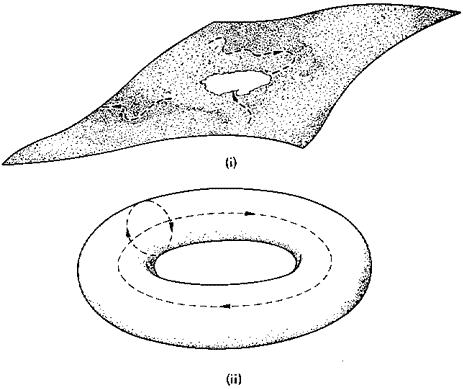 |
| Figure 10: Holes in space Space is here represented by a surface on which explorers crawl, leaving their tracks as broken lines. (i) The explorers 'fall off' the edge of the world or into the hole. (ii) They can circumnavigate the 'universe' without leaving the space - this surface does not have a boundary, even though it is limited in size and there is a hole in it. |
It is entirely possible that the universe on a large scale has a shape analogous to the torus in Figure 10(ii) in which case space would not extend for ever, but curve back round on itself Of course, it may not have a big hole in the middle - it could be more like a sphere - but in either case we could in principle travel all around it and visit every region. In colloquial jargon, we could 'do' the whole universe on a sort of cosmic package tour. And just as terrestrial globetrotters often leave London for Moscow but return from New York, so our intrepid cosmonauts might circumnavigate the cosmos, in what they regard as a fixed and straight flight path, returning from the direction opposite to their one of departure.
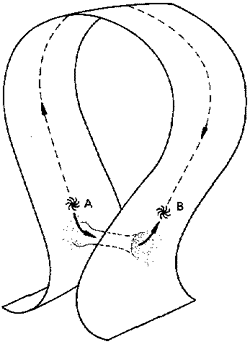
| The topology of the universe might be much more complicated than either the simple 'torus' or 'sphere', and contain a whole network of holes and bridges. One could imagine it as rather like a Swiss cheese, with the cheese being spacetime and the holes breaking it up into a complicated topology. In addition it must be remembered that the whole monstrosity is also in a state of expansion. Space and time would then be connected to themselves in a bewildering way. It would be possible, for instance, to go from one place to another by a variety of routes - each apparently a straight path - by threading through the labyrinth of bridges. The idea of a space bridge giving almost instan- taneous access to some distant galaxy is much beloved of science fiction writers. The possibility of avoiding the long route through intergalactic space would be most appealing if giant wormholes really do thread the universe. Taking the canvas analogy, such a hole would be represented by curving the canvas over in a U shape and joining the two folds together at a certain place to form a tunnel (see Figure 11). Unfortunately, there is no evidence whatever that such features really exist, but neither can they be ruled out. In principle our telescopes should be able to reveal just what shape the universe is, but at present it is too difficult to untangle these geometrical effects from other, more mundane, distortions. |
|
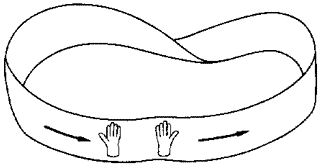 |
| Figure 12: Möbius Strip The Möbius strip has the strange property that a right-handed glove changes into a left-handed glove when transported once around the strip. (No distinction is to be made between the front and reverse surfaces of the strip.) |
Still more bizarre possibilities come to mind. When our surface (i.e. space) is 'connected up' with itself, it could contain a twist, like the famous Möbius strip (see Figure 12). In this case it would no longer be possible to distinguish left-handed from right-handed. Indeed a cosmic circumnavigator might return as a mirror image of himself, with his left and right hands interchanged!
An important point to grasp is that all these spectacular and unusual features of space could be deduced by its inhabitants entirely on the basis of observations from within it. Just as it is not necessary to leave the Earth to conclude that it is round and finite, so we need not have the higher-dimensional overview of perceiving, say, the 'hole' in the middle of a 'doughnut' universe to deduce that it is there. Its existence has consequences for space without our ever worrying about what is 'in' the hole, or what is 'outside' the finite universe. So to regard space as full of holes does not require one to specify what the holes are physically - they are outside our physical universe and their nature is irrelevant to the physics that we can actually observe.
Just as there could be holes in space, so there could be holes in time. A crude cut in time would presumably manifest itself by a sudden cessation of the universe, but a more elaborate possibility would be closed time, analogous to spherical or toroidal space. A good way of visualizing closed time is to represent time by a line: each point on the line corresponds to a moment of time. As usually conceived the line stretches away in both directions without limit, but later we shall see that the line may have one, or two, ends: i.e. a beginning or end of time. However, the line could still be finite in length without having ends, for example by closing it into a circle. If time were really like this, it would be possible to say how many hours constituted the entire duration of time. Often closed time is described by saying that the universe is cyclic, with any event repeating itself ad infinitum, but this picture presupposes the dubious notion of a flow of time, sweeping us repeatedly round and round the circle. As there is no way to distinguish one trip around from the next, it is not really correct to describe such an arrangement as cyclic.
In a closed-time world the past would also be the future, opening up the prospect of causal anarchy and temporal paradoxes frequently discussed by science fiction writers. Worse still, if time joins up with itself similarly to the twisted strip shown in Figure 12 it would not be possible to distinguish forwards or backwards in time anyway-just as there is no distinction between left and right hands in a Möbius-type space. Whether or not we would notice such bizarre properties of time is not clear. Perhaps our brains, in an attempt to order our experiences in a meaningful way, would be unaware of these temporal gymnastics.
Although edges and holes in space and time might seem like a mad mathematician's nightmare, they are taken very seriously by physicists, who consider that such structures may very well exist. There is no evidence for the 'laceration' of spacetime but there is a strong suggestion that space or time might develop edges which have borders, or boundaries, so that rather than tumbling unsuspectingly off the edge of creation, we should be painfully and, it turns out, suicidally aware of our impending departure ('holes with teeth'). Glancing once again at Figure 10(i), it is clear that the hole which is simply cut in space starts abruptly. There are no warning features in the vicinity of the edge to herald the imminent discontinuity. Likewise with similar holes in time: nothing would herald the demise of the universe, or some portion of it. Consequently, our physics cannot predict (or deny) the existence of these holes. However, holes or edges that develop gradually out of 'ordinary' spacetime could be, and indeed are, predicted by sound physical principles that most physicists accept.
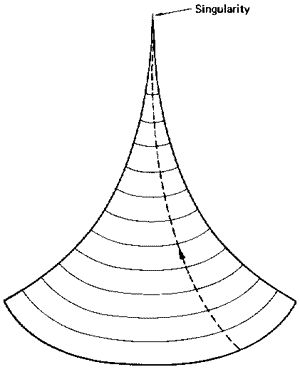 |
| Figure 13: Hole with teeth Space (the surface) curves progressively more until it pinches off altogether at a point, and stops. A curious observer (broken line) who explores near the tip risks disappearing for good off the end - he can never return. However, he is well warned of the impending end as he becomes violently squeezed into the diminishing space near the tip. |
Figure 13 is an attempt to depict for a two-dimensional surface what a heralded edge to space - a hole with teeth - might look like. The surface is a cone-like structure that tapers gradually but relentlessly to a point known as a cusp: crudely speaking the spike is infinitely sharp, so nothing can 'turn over' the tip and climb down the other side. An object which approaches the tip starts to feel uncomfortable as the increasing curvature tries to bend it, and the diminishing room constricts it. Very near the tip the object becomes progressively squeezed, and it can only reach the tip itself by being crushed down out of existence - compressed to nothing at all - for the tip has no size. The price paid for visiting the tip is the destruction of all extension and structure; the object can never return.
These cusp-like edges to spacetime from which no traveller can return are predicted by Einstein's theory of relativity, and are known as singularities. The escalating curvature in their vicinity corresponds physically to forces of gravity, which would drag all bodies apart and smash them into an ever-decreasing volume. One way in which such an unpleasant feature might occur is from the gravitational collapse of a burnt out star. When a star's fuel is exhausted, it loses heat and cannot sustain enough internal pressure to support its own weight, so it shrinks. In rather large stars, the shrinkage becomes so rapid that it amounts to a sudden implosion and the stars contract, perhaps with- out limit. A spacetime singularity forms and much, maybe all, of the star could disappear into it. Even if it does not, curious observers who follow its progress can still run into the singularity. It is widely believed that if a singularity occurs, it will be located inside a black hole where one cannot see it without falling in and leaving the universe.
Another type of singularity could have existed at the birth of the universe. Many astronomers believe that the big bang represents the debris which erupted from a singularity which was literally the creation of the universe. A big bang singularity could amount to a past temporal edge to the cosmos - a beginning of time, and space as well, in addition to the origin of all matter. Similarly there could be an edge to time in the future, at which the whole universe will disappear for good - space and time with it - after the usual crunching and annihilation. Further images of the end of the universe can be found in my book The Runaway Universe.
Having described some of the more extraordinary features that modern physics permits space and time to possess, it is worth returning to jiffyland and the concepts of quantum theory in an attempt to understand what the frothy substructure really means. In chapters 1 and 3 we discovered how electrons and other subatomic particles do not simply move from A to B. Instead their motion is controlled by a wave, which can spread out, occasionally washing through regions that are quite remote from the straight path. The wave is not a substance but a wave of probability: where the wave disturbance is slight (e.g. far from the straight path) the chances of finding the particle are slim. Most of the wave motion concentrates along the classical Newtonian route, which is therefore the most probable path. This bunching effect is exceedingly pronounced for macroscopic objects like billiard balls, whose wavelike spreading we never notice.
If we fire a beam of electrons (or even a single electron) from a gun, we can write down a mathematical expression for the wave, which moves according to the famous Schrödinger equation. The wave displays the important wavelike property of interference so if; for example, the beam strikes two slits in a screen, it will pass through both and the bifurcated disturbance will recombine in a structured pattern of peaks and troughs. The wave describes not one world, but an infinity of worlds, each containing a different path. These worlds are not all independent - the interference phenomenon shows that they overlap each other and 'get in each other's way'. Only a direct measurement can show which of this infinity of potential worlds is the real one. This raises delicate and profound issues of what is meant by 'real' and what constitutes a measurement, questions which will be thoroughly discussed in the coming chapters, but for now we merely note that when a physicist wishes to describe how an electron moves, or in general how the world changes, he deals with the wave and examines its motion. It is the wave which encodes all the available information about the electton's behaviour.
If we now picture all the possible worlds - say, each with a different electron trajectory - as a sort of gigantic, multi-dimensional superworld, in which all the alternatives are placed in parallel on an equal footing, then we can regard the world which is found to be 'real' on observation to be a three-dimensional projection from, or section through, this superworld. To what extent the superworld can be regarded as actually existing will be mentioned in due course. Basically we need a different world for each electron path, which usually means that we need an infinity of them, and similar infinities of worlds for every atom or subatomic particle, every photon and every graviton in existence. Clearly this superworld is a very big world indeed with infinite dimensions of infinity.
The idea that the world we observe might be a three-dimensional slice through, or projection of; an infinite-dimensional superworld may be hard to grasp. A humbler example of a projection may help. Consider an illuminated screen used to project the silhouette of a simple object, such as a knobbly potato. The image on the screen gives a two-dimensional projection of what is really a three-dimensional shape; i.e. the potato. By reorienting the potato, an infinite variety of silhouette shapes can be obtained, each representing a different projection from the larger space. Likewise, our observed world is shaped as a projection from the superworld - which projection being a matter of probability and statistics. At first sight it might seem that reducing the world to a sequence of random projections is a recipe for chaos, each successive moment presenting our senses with a completely new panorama, but the dice are heavily loaded in favour of the well- behaved, law-like Newtonian changes, so that the jerky fluctuations, which undoubtedly exist, are safely buried among the microscopic recesses of matter, only manifesting themselves on a subatomic scale.
Just as a Newtonian particle moves in such a way as to minimize its action, and a quantum wave bunches along the same path of least activity, so when it comes to gravity we find that space also conserves its activity. The quantum froth of jiffyland fuzzes out the minimal motion somewhat, but only on the absurdly small scale discussed in the earlier part of this chapter. Thus, space itself must be described by a wave, and this spacewave will display interference properties too. Moreover, in the same way that we may construct a different world for each electron trajectory, so we may construct a different world for each shape of space. Stitching them altogether gives us an infinite- dimensional superspace. Contained in superspace are all the possible spaces - doughnuts, spheres, spaces with wormholes and bridges - each with a different froth arrangement; an infinity of geometric and topological arrangements and rearrangements. Each space of superspace will contain its own superworid of all possible particle arrangements. The world of our senses is apparently a single, three-dimensional element projected out of this stupendously infinite superspace.
We have now moved so far from the commonsense view of space and time that it is worth pausing to take stock. The route to superspace is a hard one to tread, each step requiring the abandonment of some cherished notion or the acceptance of an unfamiliar concept. Most people regard space and time as such fundamental features of expenence that they do not question their properties in any way. Indeed, space is frequently envisaged as completely devoid of properties - an empty, featureless void. The hardest concept to accept is that space can have shape. Material bodies have shape in space, but space itself seems more like a container than a body.
Throughout history there have been two schools of philosophy concerning the nature of space. One school, of which Newton himself was a member, taught that space is a substance which not only has a geometry, but can also display mechanical features. Newton believed that the force of inertia was caused by the reaction of space on an accelerating body. For example, when a child whirling around on a roundabout feels a centrifugal force, the origin of this force is ascribed by Newton to the surrounding space. Similar ideas have been pro- posed for time, the analogy with a flowing river most closely implying an association with substance.
In contrast to these images, the alternative school proposes that space and time are not things at all, but merely relations between material bodies and events. Philosophers such as Leibniz and Ernst Mach denied that space could act on matter, and argued that all forces are due to other material bodies. Mach suggested that the centrifugal force acting on the child who rides the roundabout is caused by the relative motion between the child and distant matter in the universe. The child feels a force because the far-flung galaxies are pushing against him, resisting the motion.
According to these ideas, discussion of space and time is just a linguistic convenience enabling us to describe relations between material objects. For example, to say that there is a quarter of a million miles of space between the Earth and the moon is merely a useful way of saying that the distance from the Earth to the moon is a quarter of a million miles. If the moon were not there, and we had no other objects or light rays to manipulate, it would appear to be impossible to know how far a certain stretch of space extended. To measure distances, or angles, in space requires measuring rods, theodolites, radar signals or some other material paraphernalia. Thus space is regarded as no more of a substance than is the quality of citizenship. Both are simply descriptions of relationships that exist between things - material bodies and citizens, respectively.
Similar ideas may be applied to the concept of time. Is it necessary to regard time itself as a thing, or only a linguistic convenience for expressing the relation between events? For example, to say that one waited for a bus for a long time really only means that the interval between arriving at the bus stop and boarding the bus is uncharacteristically dilatory. The duration of time is a mode of speech describing the temporal relation between these two events.
When we approach the idea of curved spacetime, it is undoubtedly more helpful to adopt the former perspective, in which space and time are treated as substance. This may not be strictly necessary from a logical point of view, but as an aid to intuition it is helpful. Visualizing space as a block of rubber gives a vivid image of what it means for space to bend or stretch. The essential feature of Einstein's general theory of relativity is that spacetime, with this curious elastic quality, can move about, i.e. change shape, the cause of this motion being the presence of matter and energy. Once the idea of a dynamical spacetime is grasped then the quantum aspects become more meaningful.
When the concepts of quantum theory
are applied to spacetime itself, the unfamiliarity is compounded
because one is elaborating the already bewildering structure of
a dynamical spacetime with the weird features of quantum theory.
Quantum mechanics implies that we must consider not one spacetime,
but an infinity of them, with different shapes and topologies. These
spacetimes all fit together after the fashion of waves, each interfering
with the other. The strength of the wave is a measure of how probable
it is that a space of that particular shape is found to represent
the actual universe when an observation is made. The spaces will
evolve, such as when the universe expands, and the overwhelming
number of these alternative worlds will expand in a very similar
way. Some of them, however, fluctuate far from the main path, like
the children in the park discussed in connection with Figure 3.
The wave strength in these maverick worlds is very low, so there
is only an infinitesimal chance that they will actually be observed.
Down at the scale of Jiffyland, these fluctuations become far more
pronounced, and random departures from smooth, unruffled space frequently
occur. 
Facing up to the existence of a superspace in which myriads of worlds are stitched together in a curious overlapping, wavelike fashion, the concrete world of daily life seems light years away. With concepts so abstract and disturbing as these, one is bound to wonder to what extent superspace is 'real'. Do these alternative worlds actually exist, or are they just terms in some mathematical formula that is supposed to represent reality? What is the meaning of the mysterious waves that regulate the motion of matter and spacetime alike and which define the probabilities for the existence of any particular world? What is 'existence' anyway in such a quagmire of insubstantial concepts? Where do we-the observers-fit into this scheme? These are some of the questions that we will turn to next. We shall see that the cosmic game of chance is far more subtle and bizarre than mere roulette.


My Books

